Menu
Login
Organizers
Poster
Important Dates

Deadline Submission of Full Paper

2025-01-14

Notification of Full Paper acceptance

2025-01-19

Start Date

2025-02-04

End Date

2025-02-06
Conference Schedule
News
1403-09-23 Read More
Geophysical Exploration and Geomechanical Modeling Geomechanical and geophysical methods are essential in understanding subsurface properties for applications such as oil and gas exploration, mining, geothermal energy, carbon storage, and infrastructure development. Geophysical Exploration Geophysical exploration uses physical methods to detect subsurface features. Key techniques include: Seismic Methods to measure acoustic wave propagation to map subsurface structures with reflection and refraction seismic surveys, microseismic monitoring.for reservoir characterization, fault detection, and stratigraphy mapping. Gravity Surveys to detect density contrasts in the subsurface using variations in gravitational field for basin modelling, salt dome identification. Magnetics to measure magnetic field anomalies caused by different rock types for mineral exploration, tectonic studies. Electrical and Electromagnetic Methods to measure electrical conductivity of rocks for groundwater mapping, hydrocarbon exploration. Geophysical Logs to measures physical properties (e.g., density, resistivity, sonic velocity) in boreholes for lithology identification, porosity determination. Geomechanical Exploration Geomechanics focuses on understanding the mechanical behavior of rocks under stress. Key aspects include: In-Situ Stress Analysis to determine the orientation and magnitude of present-day stresses using techniques like borehole breakout analysis and hydraulic fracturing tests. Rock Mechanics Testing to measure properties like Young’s modulus, Poisson's ratio, and compressive strength. Field Testing to Use methods like plate load tests and shear tests. Fault and Fracture Characterization to analysis of fault orientation, cohesion, and frictional properties. Stability Assessments to evaluate wellbore stability, slope stability, and subsidence potential. Integration of Geomechanics and Geophysics Combining geomechanical and geophysical methods enhances subsurface modeling: Seismic-Geomechanical Coupling uses seismic data to estimate rock properties (e.g., Poisson's ratio) and stress distributions. Reservoir Modeling utilize geophysical surveys provide structural maps, while geomechanical models simulate stress and deformation. Fracture Modeling i ntegrates seismic attributes (e.g., anisotropy) with geomechanical simulations to predict fracture networks. Carbon Storage and Induced Seismicity use geomechanical models assess caprock integrity, while geophysical methods monitor subsurface CO₂ movement and detect microseismic events. Applications of Integration Hydraulic Fracturing : Geophysics : Identifies optimal fracture zones and monitors induced microseismicity. Geomechanics : Predicts fracture propagation paths, stress shadow effects, and fracture containment. Carbon Capture and Storage (CCS) : Geophysics : Tracks CO₂ plume migration using seismic surveys. Geomechanics : Evaluates caprock integrity and risks of fault reactivation. Geothermal Energy : Geophysics : Maps subsurface heat sources and fracture networks. Geomechanics : Assesses the impact of fluid injection on reservoir stability. Reservoir Management : Geophysics : Provides 4D seismic data for reservoir changes. Geomechanics : Predicts compaction, subsidence, and wellbore stability. Challenges in Integration Data Uncertainty : Geophysical data resolution may not capture fine-scale heterogeneity critical for geomechanical modeling. Computational Complexity : Coupled geophysical-geomechanical simulations require significant computational resources, especially for 3D and time-dependent models. Interdisciplinary Knowledge : Effective integration requires expertise in both geophysics and geomechanics, which can be challenging to coordinate across teams. Emerging Trends Machine Learning : Advanced algorithms for integrating multi-scale geophysical and geomechanical datasets. Real-Time Monitoring : Combining geophysical monitoring (e.g., microseismicity) with adaptive geomechanical modeling for proactive decision-making. Coupled Multiphysics Simulations : Incorporating thermal, hydraulic, and chemical processes in addition to geophysical and geomechanical coupling. By bridging geomechanics and geophysics, engineers and geoscientists gain a comprehensive understanding of subsurface behavior, enhancing exploration success and operational safety.
2024-12-04 Read More
Enhanced Oil Recovery (EOR) EOR increases oil recovery rates significantly, extending the productive life of reservoirs, and it enables recovery of oil from mature fields that have undergone primary and secondary recovery. EOR techniques are broadly classified into three main categories: Thermal Recovery Thermal Recovery involves the application of heat to reduce the viscosity of heavy oil, making it easier to flow. Steam is injected into the reservoir to heat the oil. The method commonly used in heavy oil and bitumen reservoirs. Gas Injection Gas Injection involves the injection of gases to either miscibly or immiscibly interact with the oil, improving its mobility. It includes carbon dioxide (CO₂) injection : CO₂ mixes with the oil to reduce viscosity and swell the oil, helping it flow to production wells. Hydrocarbon gas injection : Lighter hydrocarbons are injected to mix with reservoir oil. Nitrogen injection : Primarily used to maintain pressure or in miscible displacement. The method is effective in light and medium oil reservoirs. Chemical Injection Chemicals are injected to improve oil displacement efficiency. It includes polymer Flooding : Polymers increase water viscosity, improving the sweep efficiency. Surfactant-Polymer Flooding : Surfactants reduce oil-water interfacial tension, aiding oil mobilization. Alkaline Flooding : Alkaline solutions react with certain crude oils to form surfactants in-situ. The method is applied in reservoirs with favorable chemical interactions Challenges of EOR High cost of implementation and operation. Requires advanced technology and infrastructure. Environmental concerns, including risks of water contamination and CO₂ handling. Reservoir-specific constraints, such as temperature, pressure, and oil properties. The integration of EOR with geomechanics involves understanding and managing the mechanical behavior of the reservoir and surrounding rocks during EOR processes. Geomechanical Considerations in EOR Reservoir Stress Changes : Fluid Injection : Techniques like steam, CO₂, or chemical injection increase pore pressure, altering the effective stress in the reservoir and potentially inducing deformation. Stress Redistribution : Changes in stress may cause fractures, faults activation, or compaction. Rock-Fluid Interactions : Thermal Expansion : In thermal EOR, injected heat causes thermal expansion of the rock matrix, affecting stress and permeability. Chemical Reactions : Chemicals can alter rock integrity through mineral dissolution or precipitation. CO₂-Induced Changes : CO₂ injection can lead to chemical interactions with carbonate rocks, weakening the formation. Reservoir Deformation : Compaction : High-pressure EOR methods can lead to reservoir compaction, impacting porosity and permeability. Subsidence : Surface subsidence can result from reservoir compaction, especially in unconsolidated formations. Fracture Dynamics : Geomechanics determines whether induced fractures propagate or stay controlled. Caprock Integrity : Maintaining the seal's integrity is critical to preventing leakage during CO₂ or fluid injection. Fault Reactivation : Pressure changes may reactivate existing faults, potentially leading to seismic events or reservoir compartmentalization. EOR plays a crucial role in meeting global energy demand while also addressing environmental sustainability challenges. Integrating geomechanics with EOR ensures enhanced recovery while minimizing risks, making it an essential aspect of modern reservoir management. Therefore, one of the main topics of the first international conference on geoenergy and the fifth national petroleum geomechanics conference is enhanced oil recovery. Researchers are invited to send their articles in these fields to the first international geoenergy conference and the fifth petroleum geomechanics conference. Conference Registration
2024-11-24 Read More
Geothermal Energy Geothermal energy is a sustainable and renewable energy source that is obtained from the internal heat of the Earth which reduces dependence on fossil fuels. This energy can be extracted through underground reservoirs of hot water, steam, or hot rocks. In specific areas of the Earth's crust where the subsurface temperatures are notably high (such as points near tectonic plates boundarie or volcanoes), the potential for extracting this energy is significantly greater. This energy has many applications today, including: Electricity Generation: Geothermal power plants use steam from reservoirs to drive turbines connected to electricity generators. Heating and Cooling: Exchange heat between buildings and the ground, offering efficient climate control. Agriculture and Greenhouses: Geothermal hot water is employed for maintaining optimal temperatures in greenhouses, fostering plant growth and increasing agricultural yield. Industrial Uses: Provides heat for processes like drying products, saltwater desalination, and mineral extraction. Tourism and Health: Natural hot springs serve as recreational and therapeutic sites. The development of geothermal systems integrates geological sciences and engineering expertise. Key considerations include: Reservoir Exploration and Modeling : Understanding geothermal reservoirs’ temperature, permeability, and rock properties through geological and geophysical studies. Drilling Challenges : High-temperature environments and fractured rocks present significant operational challenges in geothermal energy extraction. Environmental Impacts : Risks of induced seismicity from fluid injection and ground subsidence from water withdrawal must be mitigated through careful monitoring and management. Economic Viability : Initial exploration and drilling costs are high, though long-term operational costs are low. Therefore, one of the main topics of the first international conference on geoenergy and the fifth national petroleum geomechanics conference is geothermal energy. Researchers are invited to send their articles in these fields to the first international geoenergy conference and the fifth petroleum geomechanics conference. Conference registration
2024-11-24 Read More
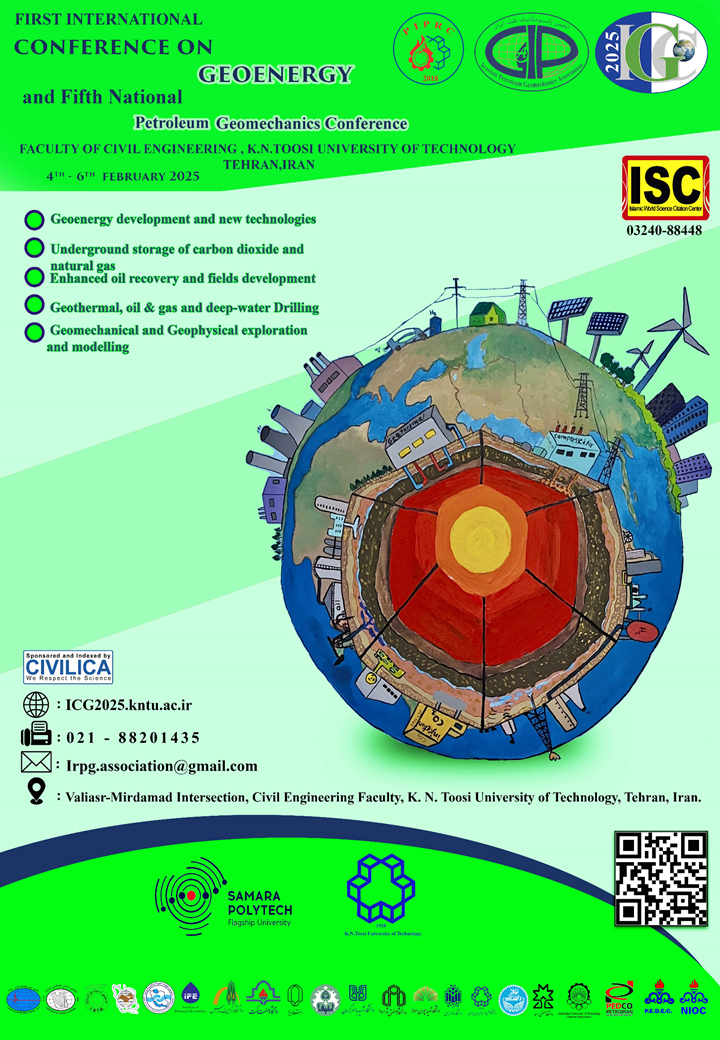
We kindly request scholars from academia and industry to submit their papers to the conference by the date 2025/01/14. Conference Topics Conference Registration
1403-08-16 Read More
Underground storage of carbon dioxide and natural gas One of the conference's main topics is the underground storage of gases, including carbon dioxide. Carbon dioxide, as a greenhouse gas, causes the warming of the earth's atmosphere, one of the solutions to solve this problem is to absorb CO2 and turn it into a liquid at a specific temperature and pressure and inject it into underground reservoirs inside the formations within geological formations with appropriate porosity and impermeable layers around it. Depleted oil and gas reserves can be used for this purpose. Today, natural gas is also stored underground. The underground storage of natural gas basically balances the gas flow in the pipeline network during different seasons. In fact, during periods of low demand, gas is injected into the ground, and during periods of peak demand, gas is withdrawn and consumed. As a result, daily and seasonal demand fluctuations are well managed, and the supply of gas will be proportional to the demand. Compressed natural gas is usually stored in depleted oil and natural gas reservoirs, underground aquifers, and salt dome formations. One of the main topics of the first international conference on geoenergy and the fifth national petroleum geomechanics conference is the underground storage of carbon dioxide and natural gas. Researchers are invited to send their articles in these fields to the first international geoenergy conference and the fifth petroleum geomechanics conference. Conference registration
Video


Keynote Speakers

Prof. Igor Vasilievich Kudinov

Head of the Physics Department, Samara State Technical University, Russia

Topic presentation: Oil and gas technologies for the production of hydrogen and carbon nanomaterials: global trends and the technological level of Samara Polytechnic University


Dr. Babitskaya Ksenia Igorevna

Associate Professor at Institute of Oil and Gas Technologies, Samara State Technical University, Russia

Presentation Topic: Enhanced oil recovery and limitation of water production restraining with chemical solutions of selective operation

Dr. Gubanov Sergey Igorevich

Deputy Director of the Institute of Oil and Gas Technologies, Samara State Technical University, Russia

Presentation Topic: Technology of thermochemical action with a heating composition for high-viscosity oil production intensification and thermal acid treatments

Prof. Peyman Pourafshary

Vice Dean for Research and Academic Affairs, School of Mining and Geosciences, Nazarbayev University
 Presentation Topic: DLVO-Based Modeling and Experimental Validation for Predicting and Controlling Fines Migration in Sandstone Reservoirs during Enhanced Oil Recovery Operations


Dr. Seyed Ali Ghoreishian Amiri
 
Senior Researcher

Department of Civil and Environmental Engineering

NTNU – Norwegian University of Science and Technology

Presentation Topic: On the implementation of hyperplastic models without establishing a yield surface


Dr Alireza Alamatsaz

PhD Petroleum Engineering, In Situ Combustion Research group, University of Calgary, Calgary, Canada


Presentation Topic: Is it time for In Situ Combustion for EOR in Iranian Heavy Oils


Prof. Siavash Ghabezloo

Professor, Laboratoire Navier, École Nationale des Ponts et Chaussées

Presentation Topic: Oil-well cements behavior for integrity assessment of CO2 injection wells

 Abstract


About the Conference

Today, with the reduction or complexity of hydrocarbon reserves, as well as the position of geoeconomics in the global security and sustainable development, the issue of geoenergy is a priority and has a vital role. Therefore, the knowledge of the earth towards new technologies in the field of geoenergy, including strategic subsurface reserves of oil, water, natural gas, development of oil and gas fields and increasing exploitation of unconventional reservoirs, geothermal energy, hazardous waste disposal, development of models Geomechanical and geophysical explorations etc. are progressing well. Holding scientific conferences is a suitable platform for exchanging new scientific findings and strengthening the collaboration between academic and industry to solve the problems in the industry. Iran Petroleum Geomechanics Association and the Oil Industry Productivity Research Institute of K.N. Toosi University of Technology will hold the first international conference on geoenergy and 5th Iranian National Conference on Petroleum Geomechanics focusing on new energies concurrently. This conference, with the support of holding four successful sessions of petroleum geomechanics conference, invites professors, researchers, industrialists, students, and those interested in these fields to help us in holding this conference by actively participating and sending their latest scientific findings.

We look forward to meeting you at this event.

Remaining time
End
Viewers' Statistics
Today : 0
Yesterday : 1
Current month : 35
Last month : 58
General statistics : 40,113
Media Partners
Samin Hamayesh - Version 44.11.0