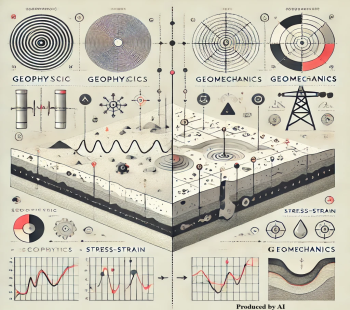
Main Conference Topic: Geophysical Exploration and Geomechanical Modeling
Geophysical Exploration and Geomechanical Modeling
Geomechanical and geophysical methods are essential in understanding subsurface properties for applications such as oil and gas exploration, mining, geothermal energy, carbon storage, and infrastructure development.
Seismic Methods to measure acoustic wave propagation to map subsurface structures with reflection and refraction seismic surveys, microseismic monitoring.for reservoir characterization, fault detection, and stratigraphy mapping.
Gravity Surveys to detect density contrasts in the subsurface using variations in gravitational field for basin modelling, salt dome identification.
Magnetics to measure magnetic field anomalies caused by different rock types for mineral exploration, tectonic studies.
Electrical and Electromagnetic Methods to measure electrical conductivity of rocks for groundwater mapping, hydrocarbon exploration.
Geophysical Logs to measures physical properties (e.g., density, resistivity, sonic velocity) in boreholes for lithology identification, porosity determination.
Geomechanical Exploration
Geomechanics focuses on understanding the mechanical behavior of rocks under stress. Key aspects include:
In-Situ Stress Analysis to determine the orientation and magnitude of present-day stresses using techniques like borehole breakout analysis and hydraulic fracturing tests.
Rock Mechanics Testing to measure properties like Young’s modulus, Poisson's ratio, and compressive strength.
Field Testing to Use methods like plate load tests and shear tests.
Fault and Fracture Characterization to analysis of fault orientation, cohesion, and frictional properties.
Stability Assessments to evaluate wellbore stability, slope stability, and subsidence potential.
Integration of Geomechanics and Geophysics
Combining geomechanical and geophysical methods enhances subsurface modeling:
Seismic-Geomechanical Coupling uses seismic data to estimate rock properties (e.g., Poisson's ratio) and stress distributions.
Reservoir Modeling utilize geophysical surveys provide structural maps, while geomechanical models simulate stress and deformation.
Fracture Modeling integrates seismic attributes (e.g., anisotropy) with geomechanical simulations to predict fracture networks.
Carbon Storage and Induced Seismicity use geomechanical models assess caprock integrity, while geophysical methods monitor subsurface CO₂ movement and detect microseismic events.
Applications of Integration
Hydraulic Fracturing:
Geophysics: Identifies optimal fracture zones and monitors induced microseismicity.
Geophysics: Tracks CO₂ plume migration using seismic surveys.
Geomechanics: Evaluates caprock integrity and risks of fault reactivation.
Geothermal Energy:
Geophysics: Maps subsurface heat sources and fracture networks.
Geomechanics: Assesses the impact of fluid injection on reservoir stability.
Reservoir Management:
Geophysics: Provides 4D seismic data for reservoir changes.
Geomechanics: Predicts compaction, subsidence, and wellbore stability.
Challenges in Integration
Data Uncertainty:
Geophysical data resolution may not capture fine-scale heterogeneity critical for geomechanical modeling.
Computational Complexity:
Coupled geophysical-geomechanical simulations require significant computational resources, especially for 3D and time-dependent models.
Interdisciplinary Knowledge:
Effective integration requires expertise in both geophysics and geomechanics, which can be challenging to coordinate across teams.
Emerging Trends
Machine Learning:
Advanced algorithms for integrating multi-scale geophysical and geomechanical datasets.
Real-Time Monitoring:
Combining geophysical monitoring (e.g., microseismicity) with adaptive geomechanical modeling for proactive decision-making.
Coupled Multiphysics Simulations:
Incorporating thermal, hydraulic, and chemical processes in addition to geophysical and geomechanical coupling.
By bridging geomechanics and geophysics, engineers and geoscientists gain a comprehensive understanding of subsurface behavior, enhancing exploration success and operational safety.