
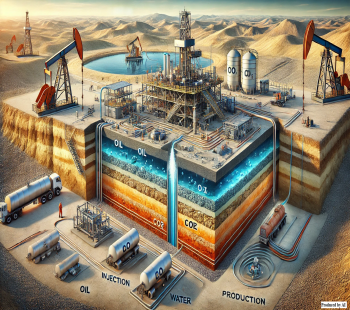
Enhanced Oil Recovery (EOR)
EOR increases oil recovery rates significantly, extending the productive life of reservoirs, and it enables recovery of oil from mature fields that have undergone primary and secondary recovery. EOR techniques are broadly classified into three main categories:
Thermal Recovery involves the application of heat to reduce the viscosity of heavy oil, making it easier to flow. Steam is injected into the reservoir to heat the oil. The method commonly used in heavy oil and bitumen reservoirs.
Gas Injection involves the injection of gases to either miscibly or immiscibly interact with the oil, improving its mobility. It includes carbon dioxide (CO₂) injection: CO₂ mixes with the oil to reduce viscosity and swell the oil, helping it flow to production wells. Hydrocarbon gas injection: Lighter hydrocarbons are injected to mix with reservoir oil. Nitrogen injection: Primarily used to maintain pressure or in miscible displacement. The method is effective in light and medium oil reservoirs.
Chemicals are injected to improve oil displacement efficiency. It includes polymer Flooding: Polymers increase water viscosity, improving the sweep efficiency. Surfactant-Polymer Flooding: Surfactants reduce oil-water interfacial tension, aiding oil mobilization. Alkaline Flooding: Alkaline solutions react with certain crude oils to form surfactants in-situ. The method is applied in reservoirs with favorable chemical interactions
Challenges of EOR
The integration of EOR with geomechanics involves understanding and managing the mechanical behavior of the reservoir and surrounding rocks during EOR processes.
EOR plays a crucial role in meeting global energy demand while also addressing environmental sustainability challenges. Integrating geomechanics with EOR ensures enhanced recovery while minimizing risks, making it an essential aspect of modern reservoir management. Therefore, one of the main topics of the first international conference on geoenergy and the fifth national petroleum geomechanics conference is enhanced oil recovery.
Researchers are invited to send their articles in these fields to the first international geoenergy conference and the fifth petroleum geomechanics conference.